When people ask what I do at Senvio, "Project Manager" is the honest two-word answer. It's also a little misleading.
On any given week I'm writing acceptance protocols, sitting in on discovery calls, defining product requirements, running QA on a release, drafting a client email in three languages, and shaping an SLA that quietly turns into recurring revenue. None of that fits neatly under the title. At a small agency, it doesn't need to - the work decides the boundaries, not the org chart.
For a long time the PM role was built around a constraint that's quietly disappearing: you couldn't do the specialist work yourself, so the job was mostly about coordinating the people who could. You lined up the developers, the QA engineer, the analyst. You managed the handoffs, chased the dependencies, and translated between what the client wanted and what each specialist needed to hear. The PM rarely produced the work - they made sure the right people produced it, in the right order, on time.
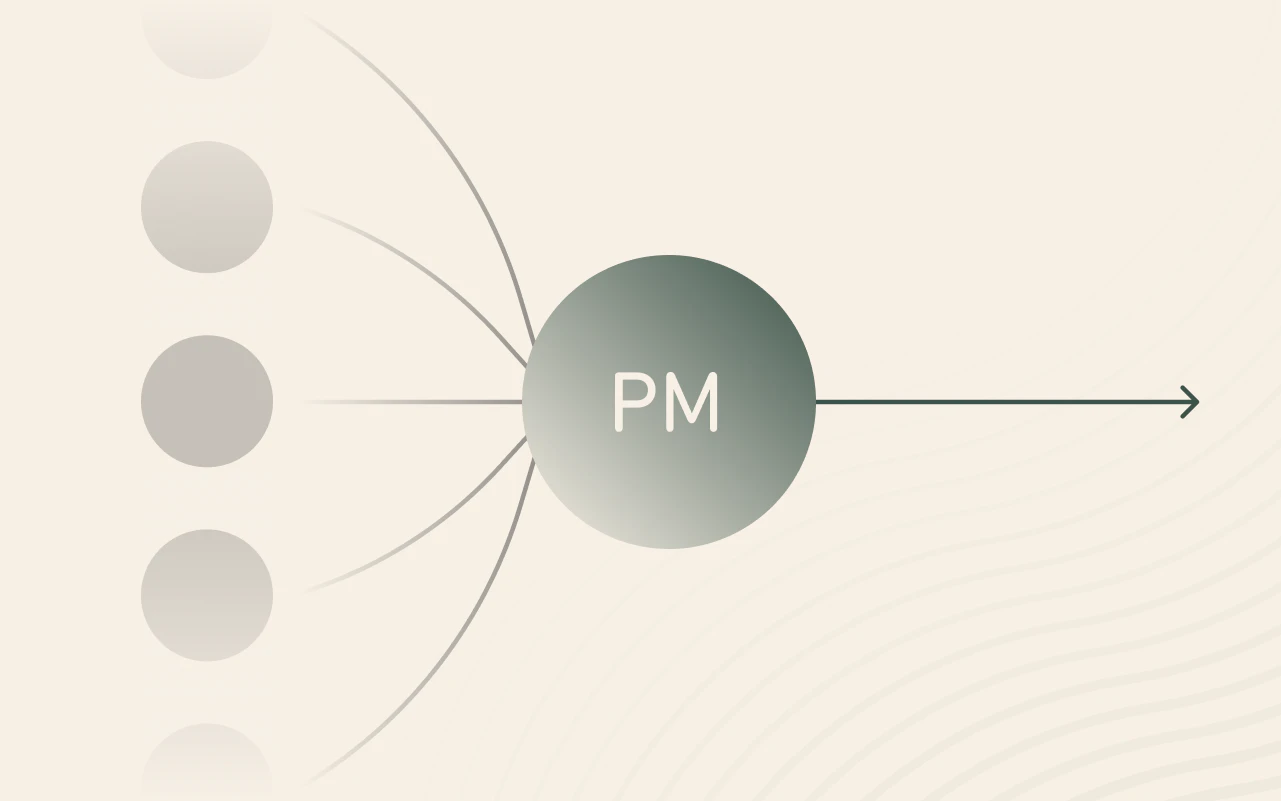
That constraint is loosening. With AI, a single project or product manager can now stand up something close to their own team of specialist agents. And that changes the role more than any process framework ever did.
What "a team of agents" actually means
This isn't a metaphor for working a bit faster. In practice, a PM today can:
- Draft a first-pass technical specification and have it critiqued before a developer ever sees it.
- Generate acceptance criteria, test plans, and edge-case lists for a feature in minutes.
- Translate a dense developer update into a clear summary a CEO can act on, in whatever language the client speaks.
- Produce client-facing documentation, draft KPIs, and discovery notes that used to need a separate writer or analyst.
- Mock up a rough design for a new feature or a brand direction - enough to put something visual in front of a client and react to it, without waiting on a designer's first pass.
- Scaffold a script or a prototype well enough to know whether an idea is even worth a developer's time.
Each of these used to be someone else's job, or a slow back-and-forth across several people. Now they're things the PM can do directly - with an agent handling the first 70% and the human supplying the judgment for the rest.
I'll be honest: I've been working this way out of necessity for the past year, long before it had a name. A small agency forces you to be useful across the whole delivery rather than one slice of it. What used to feel like a quirk of working somewhere small now looks like a head start.
The role shifts from coordinating people to directing capability
When the specialist work is a prompt away, the bottleneck moves. The scarce skill is no longer "can you get the right people in a room." It's "do you know what good looks like across all of these areas, and can you tell when the output is wrong."
That last part is where the role earns its keep. AI agents are fast, confident, and frequently wrong in ways that matter - a shaky technical assumption, a contract clause that causes trouble later, a client sentence that lands badly. Catching that requires having done enough of the adjacent work to recognize the shape of a problem before it ships. The PM becomes less of a coordinator and more of an editor-in-chief: setting direction, judging quality, and owning the through-line of the whole project.
The same shift is happening to developers
The PM role isn't changing in isolation. Developers are going through the same transition - away from writing every line by hand, toward directing AI to generate code and then reviewing, correcting, and integrating it. The valuable skill is increasingly architectural judgment and the ability to spot what the model got subtly wrong, not raw typing speed.
The pattern is identical across both roles: the tools handle execution, and the human moves up a level to judgment, direction, and accountability. Neither role disappears. Both move toward the part of the job a model can't own - knowing what should be built, and whether what came back is actually right.
What an agent still can't do
It would be easy to read all this as "AI does the work now." It doesn't. It does the production. There's a whole category of the job that has no agent, and probably won't for a while.
No agent builds trust with a nervous client three weeks before a hard go-live. No agent reads the room on a discovery call and senses that the real problem isn't the one written in the brief. No agent sits in a messy brainstorm where half-formed ideas collide and something genuinely new comes out of the collision. The spark of an idea, the judgment to back an unproven direction, the human reassurance that makes a client comfortable enough to keep going - those are still ours.
If anything, offloading the production work frees up more time for exactly that. The parts of the role that are most human - connection, trust, innovation - get more room, not less. The agents handle the documents and the drafts. The relationships and the ideas are still the job.
What this means for how teams are built
If one PM can cover the ground that used to need a technical writer, an analyst, a QA pass, and a coordinator, the shape of a project team changes. Smaller teams take on work that previously required more hands. The clients don't see a chain of specialists handing off to each other - they see one person who understands their problem end to end and delivers against it.